A Guide for Working Adults
You set your alarm early. You put in honest hours every single day. You handle tough customers, fix complex problems, and keep your household running. Yet, when you look at your paycheck at the end of the month, you might feel like you are running in place.
Prices for food, housing, and everyday needs keep rising. It is easy to feel stuck when your hard work does not lead to higher earnings. You might wonder if you have hit a ceiling in your current position.
If you have thought about earning more money, changing careers, or stepping up into management, a natural question comes to mind: Is going back to school actually worth it?
At Matched Benefits, our goal is simple. We help working adults find clear, practical guides on real education programs, financial assistance, and workplace benefits. We believe that better information leads to better decisions for your family and your wallet.
The truth is that education and skills training can unlock higher pay and better job security. However, going back to school only pays off if you do it strategically. You do not need to collect random college credits or take on heavy debt. You need a simple, clear plan that fits your life, builds on what you already know, and connects straight to a higher-paying job.
This complete guide will show you how to navigate going back to school as a busy adult. You will learn how to pick the right program, balance your busy week, transfer life experience into real college credit, and secure financial support to pay for it all.

Map Out Your Career Destination Before Choosing a Program
Many adults make costly mistakes when considering education. They start by picking a school or looking through course catalogs. They sign up for classes before knowing exactly what job they want.
A far smarter strategy is to work backward. Start with the paycheck and job stability you need. Then, find out what specific training or degree local employers actually require.
Look at Local Job Listings First
Instead of asking, “What should I study?”, start by asking: “What specific job do I want, and what credential do I need to get hired?”
- Open two or three job search websites.
- Search for job titles in your area that pay the salary you want to earn.
- Read five to ten job descriptions carefully.
- Look closely at the section marked “Requirements” or “Qualifications”.
If employers in your region repeatedly ask for a specific industry certification, an associate degree, or a specialized license, you have found your target. If employers prioritize three years of direct experience over a four-year degree, taking on massive tuition debt for a bachelor’s degree might not be your best path. Education raises your income when it gives you skills that employers actively seek. A degree alone does not guarantee a higher salary, but the right skill set does.
Focus on Modern High-Growth Fields
When picking a career path, focus on industries that are actively hiring and offer solid starting pay. Several fields consistently show strong demand for adult learners:
- Healthcare Support: Roles like medical billing specialists, health information technicians, and dental assistants offer fast entry through 6-month to 2-year programs.
- Information Technology (IT) and Cybersecurity: Computer support specialists, network managers, and cybersecurity technicians often start with short-term professional certifications rather than traditional four-year degrees.
- Project Management and Operations: Many companies value practical coordinators who can lead teams, organize supply chains, and manage projects.
- Skilled Trades and Technical Operations: HVAC repair, industrial maintenance, and electrical technician roles offer strong earnings and high job security.

Marcus Maps Out His Logistics Career
Marcus is 34 years old and works as a warehouse lead hand. He makes $21 an hour. He works hard on his feet all day, but he knows he cannot do physical labor forever. Marcus wants to move into a Logistics Manager role, which pays $34 an hour in his city.
Instead of signing up for a full four-year business administration degree, Marcus researched local job postings. He noticed that four out of five local logistics postings required two main things: working knowledge of enterprise inventory software and a Certified Supply Chain Professional (CSCP) credential or an Associate Degree in Logistics.
Marcus realized he did not need to spend four years and $40,000 on a general business degree. Instead, he found an accredited community college program that offered a 9-month online certificate in supply chain management. The credits from this certificate could also transfer directly toward an associate degree later if he decided to keep studying. By mapping out his destination first, Marcus saved thousands of dollars and cut his training time by three years.
| Career Goal | Typical Required Credential | Average Training Time | Focus Area |
|---|---|---|---|
| IT Support Specialist | CompTIA A+ / Google IT Certificate | 3 to 6 months | Hardware, troubleshooting, software support |
| Medical Records Specialist | Certified Coding Associate (CCA) | 6 to 12 months | Medical terminology, health data, billing |
| Logistics Coordinator | Supply Chain Certificate / Associate Degree | 9 to 18 months | Inventory control, operations, vendor relations |
| Project Manager | PMP or CAPM Certification | 4 to 8 months | Budgeting, team leadership, project flow |
Finding Programs That Work Around Your Busy Schedule
The biggest barrier for adult learners is rarely a lack of motivation. The biggest barrier is time.
You already have a full life. You have shift hours, monthly bills, family responsibilities, and household chores. You cannot simply pause your life for two years to sit in a college classroom every morning.
That is why finding a flexible, practical learning format is essential.
Understanding Modern Learning Formats
- Asynchronous Online Classes: These courses let you log in, watch lectures, and complete assignments on your own schedule, provided you meet weekly deadlines. This format works well if you work irregular shifts or need to study late at night after your kids go to sleep.
- Synchronous Online Classes: These are live online courses. You log in to a video classroom at specific set times, such as Tuesday and Thursday evenings from 6:30 PM to 8:30 PM. This option offers structured interaction with instructors without requiring a commute.
- Hybrid Programs: Hybrid courses combine online lectures with occasional hands-on campus visits. This style is common in healthcare, automotive repair, and technical fields where you must practice physical skills in a lab setting.
- Self-Paced Competency-Based Programs: These unique programs let you move through course material as fast as you master the concepts. If you already know a topic from work experience, you can take the assessment right away and move on to the next topic.
Perform a Honest Weekly Time Audit
Before enrolling in any class, perform an honest audit of your week. Most college courses require about three hours of study time per week for every credit hour taken. A standard 3-credit course will require around 9 hours of total time each week.
Ask yourself these critical scheduling questions:
- How many dedicated study hours can I clear each week without burning out?
- Are class lectures live at specific hours, or can I complete them whenever I am free?
- Does the program require mandatory on-campus lab work or clinical placements?
- Can I safely maintain my current work hours while completing this training?
- What is the school policy if a family emergency forces me to pause my studies for a term?

Sarah Balances Work and IT Training
Sarah is 29 and works 40 hours a week as a retail sales associate. She is also a mother to a 6-year-old child. Sarah wanted to enter the technology field as an IT Support Technician to increase her income and secure standard weekday hours.
She knew she could not attend traditional daytime classes. She looked for an online IT certificate program designed specifically for working adults. The program was fully asynchronous and required 10 to 12 hours of study time each week.
Sarah built a realistic weekly routine:
- Monday through Friday: 1 hour of study after her child went to bed (5 hours total).
- Saturday Morning: 4 hours of study at the local library while her partner watched their child.
- Sunday Afternoon: 3 hours of review and assignment submission.
By committing to a steady 12 hours a week, Sarah completed her certificate in six months without missing work or giving up family time. She used her new credential to land an entry-level helpdesk role that paid $5 more per hour with weekends off.
Don’t Start From Scratch: Turn Your Experience Into College Credits
One of the biggest secrets in adult education is that you rarely start at zero. You bring years of practical work experience, military service, corporate training, and existing problem-solving skills.
Many colleges offer pathways to convert your existing life and work experience into official college credits. Getting credit for what you already know reduces tuition costs and helps you graduate much faster.

Main Ways to Earn Experience Credit
- Prior Learning Assessments (PLA): A PLA allows you to assemble a portfolio of your past work projects, training certificates, job descriptions, and professional achievements. Academic evaluators review your portfolio to determine if your real-world experience matches specific course learning requirements.
- CLEP and DSST Examinations: The College-Level Examination Program (CLEP) lets you take a single exam to prove mastery of general subjects like College Composition, Psychology, Introductory Business Law, or College Algebra. Passing an $90 CLEP exam can earn you 3 college credits, saving you hundreds of dollars compared to taking a traditional course.
- Military and Workplace Training Evaluation: If you served in the military or completed corporate training courses (such as safety training, leadership seminars, or technical certifications), organizations like the American Council on Education (ACE) may have already evaluated those programs for college credit.
- Transcript Audits of Past Coursework: If you took college courses five, ten, or fifteen years ago, those credits may still be valid. General education courses like English Composition, History, and College Mathematics rarely expire.
Always Confirm Transfer Policies First
Before signing an enrollment agreement or paying fees, ask the school’s admissions office for a formal transfer credit evaluation. Get written confirmation of exactly which past credits and work experiences will count toward your program.
Never rely on verbal estimates. Knowing your credit standing upfront prevents you from paying for or retaking classes you have already mastered.
Elena Cuts 6 Months Off Her Degree
Elena is 38 years old. She worked as an administrative assistant at a medical clinic for five years. She wanted to complete an Associate Degree in Healthcare Management to qualify for a Clinic Supervisor position.
Elena had taken two community college courses twelve years earlier before stopping to raise her family. She assumed those old credits were gone and that her five years of clinic work would not count toward a degree.
During her consultation with an academic advisor, Elena requested a formal evaluation:
- Her two old college classes were accepted as general electives (6 credits).
- Her workplace certifications in HIPAA compliance and medical office scheduling were evaluated through a Prior Learning Assessment (6 credits).
- She took and passed the CLEP exam for Principles of Management (3 credits).
In total, Elena earned 15 credits before her first day of class. That equaled five entire courses. She saved over $1,800 in tuition and cut six full months off her degree path, allowing her to step into her supervisory role much faster.
Crunching the Real Numbers: Measuring ROI and Program Costs
Education is a financial investment in your future. Like any investment, it must make clear financial sense. You should evaluate an educational program using real, clear numbers rather than emotional marketing promises.
Uncovering the Total Program Cost
The sticker price listed on a school brochure is rarely the total amount you pay. To find the true cost of a program, you must calculate all related expenses:
- Tuition: The cost per credit hour multiplied by the required credits.
- Mandatory Student Fees: Technology fees, lab usage fees, registration costs, and facility charges.
- Books and Digital Access Codes: Course materials, required software subscriptions, and hardware access.
- Transportation or Gear: Gas, parking passes, or specialized uniform items for technical programs.
- Opportunity Costs: Any income you might lose if you need to reduce your working hours for labs or clinical rotations.
How to Calculate Your Personal Payback Period
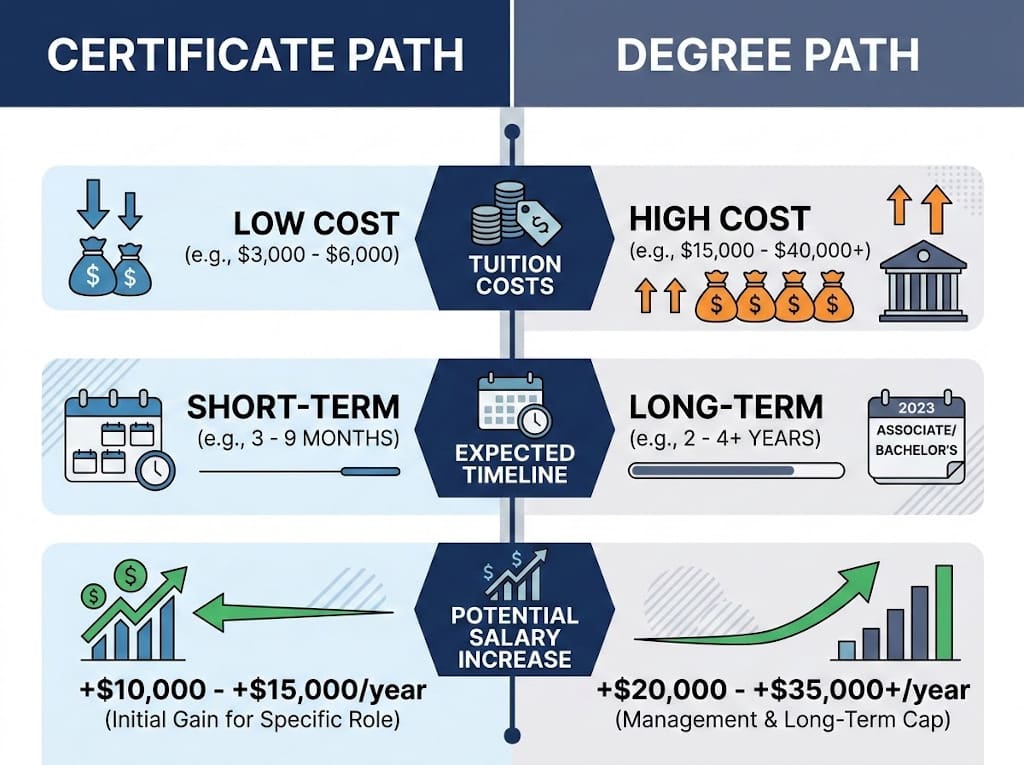
You can calculate your expected Return on Investment (ROI) with a simple formula. First, determine your net out-of-pocket program cost after subtract grants or employer tuition aid. Second, calculate your expected annual pay raise after completing the program. Finally, divide your total out-of-pocket cost by your yearly pay raise to find your payback period in years.
Payback Period (Years) = Net Out-of-Pocket Program Cost / Expected Annual Salary Increase
For example, if a program costs $4,000 out-of-pocket, and it helps you secure a position that pays $8,000 more per year, your payback period is just six months. That represents a very solid investment.
On the other hand, if a program costs $35,000 out-of-pocket and only leads to a $2,000 annual pay raise, your payback period would stretch to over 17 years. That program would not make financial sense for a working adult.
Hard Questions to Ask Admissions Representatives
- What is the total overall cost of this program, including all fees, books, and materials?
- What percentage of students who start this program actually graduate?
- What percentage of graduates land jobs in their field within six months of completion?
- What is the average starting salary for graduates of this specific program?
- Does this program satisfy all state licensing requirements for my field?
Navigating Financial Benefits, Grants, and Employer Support
You do not have to carry the financial burden of going back to school entirely on your own. Numerous financial resources exist specifically to assist adult learners. Knowing where to look can significantly lower your out-of-pocket costs.
Unlocking Tax-Free Employer Tuition Assistance
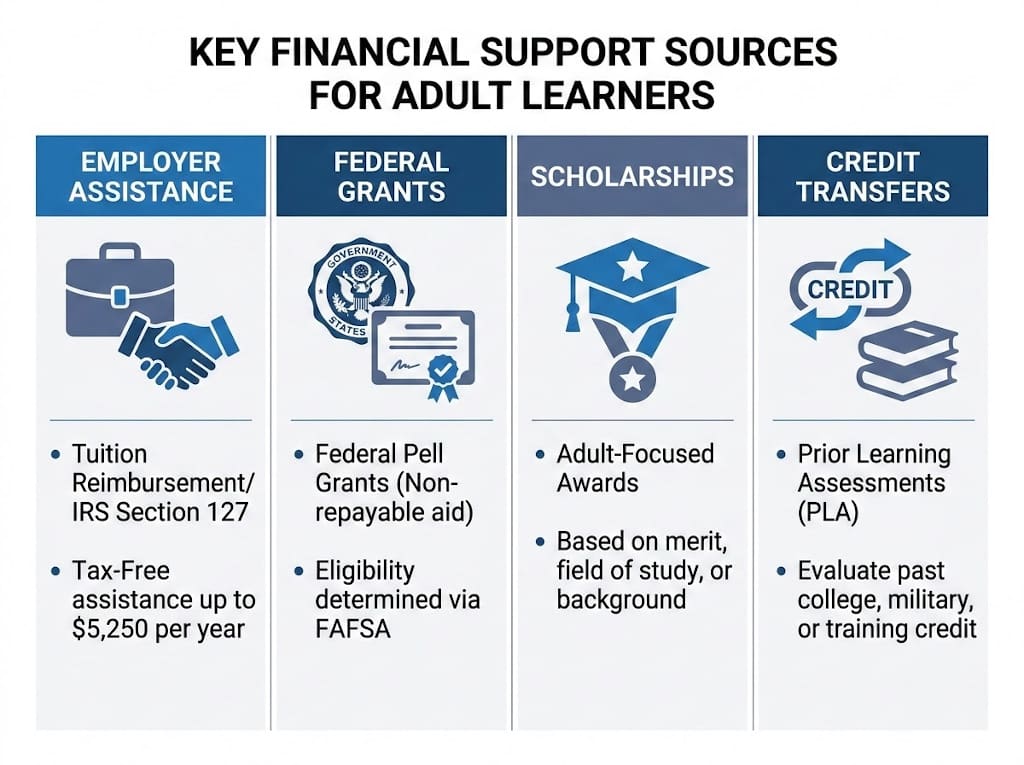
One of the most valuable yet underused workplace perks is employer tuition assistance. Under IRS Section 127, employers can provide up to $5,250 per year in tax-free tuition assistance to their employees for qualified education programs.
Many companies offer this benefit to full-time and part-time workers after a brief initial employment period. The courses do not always need to directly relate to your current daily tasks, provided they support a reasonable career path within the company.
Check your employee handbook or talk directly with your Human Resources representative. Ask if your workplace offers tuition assistance, tuition reimbursement, or direct payment plans with partner colleges.
Federal Grants and State Workforce Funds
Many adult learners assume federal student aid is reserved for recent high school graduates. That assumption is incorrect.
- Federal Pell Grants: Grants do not need to be repaid. Eligibility is based on your income and household size, not your age. You can apply by filling out the Free Application for Federal Student Aid (FAFSA). Even if you work full-time, you may still qualify for partial grant assistance depending on your household income.
- State Workforce Innovation and Opportunity Act (WIOA) Funds: Many states receive federal funding to help adult workers build high-demand job skills. If you are underemployed or working in a declining industry, state workforce agencies can fully cover short-term career certificates in fields like healthcare, logistics, and IT.
- Professional Association Scholarships: Industry groups, trade unions, and local community foundations frequently offer small grants and scholarships ($500 to $2,000) tailored for adult students returning to school.
Avoiding High-Interest Debt Traps
Be extremely cautious before considering high-interest private student loans. Private loans lack the flexible repayment options, income-driven repayment structures, and deferment safeguards provided by federal loans.
Always maximize non-repayable assistance—such as employer benefits, federal grants, adult scholarships, and credit transfers—before considering any form of student borrowing.
| Aid Source | Repayment Required? | Tax Impact | Key Eligibility Requirement |
|---|---|---|---|
| Employer Section 127 | No | Tax-Free up to $5,250/yr | Employment standing & passing grades |
| Federal Pell Grant | No | Tax-Free for tuition/books | Financial need based on FAFSA |
| State WIOA Grants | No | Tax-Free | Residency & local high-demand field |
| Federal Direct Loans | Yes (Low Interest) | N/A | FAFSA completion & accredited school |
| Private Loans | Yes (High Interest) | N/A | Credit score & co-signer requirements |
Five Practical Action Steps You Can Take Right Now
Transforming your income and career path does not happen overnight. However, moving from “someday” to a concrete plan starts with taking simple, manageable steps. You do not need to choose a school or enroll in a program today.
Follow this five-step action checklist this week to gain momentum:
- Select Three Target Job Listings: Search local job boards for three specific positions that pay the salary you want to earn. Print or save the job descriptions and highlight the common education credentials, degrees, or certifications required.
- Review Your Employer Benefits: Check your workplace handbook or ask your HR department if your employer provides tuition assistance under Section 127 or offers discounts with partner institutions.
- Gather Past Transcripts and Records: Contact high schools, military branches, training providers, or colleges you previously attended. Order official copies of your transcripts so you are ready for credit transfer evaluations.
- Request Detailed Program Cost Sheets: Contact two or three accredited community colleges, technical centers, or online universities that offer your target credential. Request full, itemized cost sheets that outline tuition, fees, and material expenses.
- Schedule a Free Academic Counseling Call: Meet with an academic advisor at your target institution. Ask direct questions about prior learning assessments, flexible scheduling options, graduation outcomes, and career placement services.
Taking these five steps puts you in full control of your future. By gathering real facts, calculating real costs, and choosing a career path that fits your life, you can make an educated decision that pays dividends for years to come.