A Complete Guide to Qualifying and Finding Your Best Option
Introduction: Taking the Guesswork Out of Health Insurance
Finding reliable health insurance can feel confusing, but it does not have to be. The Affordable Care Act, often called ACA coverage or Obamacare, exists to help individuals and families get quality, low-cost health plans. Health insurance is much more than a monthly expense or an item on your to-do list. It serves as an essential safety net that protects your family finances and gives you regular access to doctors, preventive checkups, and necessary medications.
Many people miss out on financial support simply because they do not know how the system works or assume they earn too much money. The rules surrounding income ranges, household sizes, and sign-up windows can seem overwhelming at first glance. However, once you learn the basics, you can easily find options that fit your personal budget and medical needs.
This guide breaks down every step of the process into simple, practical language. Whether you work for yourself, manage multiple part-time jobs, or recently experienced a major life change, understanding your choices puts you in complete control. As an educational resource guide and information hub, Matched Benefits helps you navigate these rules so you can make informed decisions with confidence.

1. Calculating Your Household Income: The MAGI Formula Made Simple
To figure out if you qualify for financial savings on the ACA Health Insurance Marketplace, you first need to estimate your household income. The Marketplace uses a specific formula called Modified Adjusted Gross Income, commonly abbreviated as MAGI.
MAGI is not simply the take-home pay you see printed on your paycheck or deposited into your bank account. Instead, it reflects your gross taxable income minus specific deductions, with a few additions added back in. For most people, MAGI is very close to the Adjusted Gross Income (AGI) line listed on your federal tax return.
When calculating your MAGI for the 2026 coverage year, you must project what your household will earn during that specific year. You need to count taxable income for yourself, your legal spouse, and any dependents who are required to file a federal tax return. You include these family members in your total household calculation even if some of them do not need health insurance coverage for themselves.
Understanding Sarah's Freelance Scenario
Calculating income is simple if you earn a steady salary, but what if your earnings change month to month? Consider Sarah, a freelance graphic designer. Sarah earns varying amounts throughout the year depending on project contracts. Some months bring steady client payments, while other months remain slow.
To estimate her 2026 MAGI accurately, Sarah reviews her income tax records from the past two years. She looks at her existing client retainer agreements, subtracts her allowed business expense deductions, and estimates potential new projects. By averaging these numbers and accounting for potential slow months, Sarah establishes a realistic annual earnings estimate for 2026.
Practical Guidelines for Varying Income Types
If your income fluctuates, follow these direct steps to build an accurate estimate:
- Freelancers and Independent Contractors: Start with your gross business earnings and subtract allowed business expenses (like software subscriptions or equipment) to determine your net self-employment income.
- Gig Economy Workers: Review your average weekly earnings across driving, delivery, or task platforms. Multiply your average weekly gross by 52, then subtract qualified mileage or expense deductions.
- Tipped Employees: Add your base hourly wage to your total estimated tip earnings over the course of the full year.
- Multiple Part-Time Job Holders: Add together the gross taxable pay from each employer's W-2 estimate. Remember to count pre-tax payroll deductions, such as retirement contributions, which lower your overall taxable gross income.
2. Household Size and the 2026 Financial Assistance Brackets
Your tax household size directly impacts how much financial assistance you can receive. A "tax household" consists of the primary taxpayer, their legal spouse, and any tax dependents claimed on their federal tax return.
It is important to notice that your tax household might differ from the physical occupants living under your roof. For example, roommates, adult children who file their own independent tax returns, or elderly relatives who are not claimed as tax dependents do not count toward your Marketplace household size.
The federal government compares your estimated household MAGI against the Federal Poverty Level (FPL) to determine your eligibility for financial discounts. These discounts come in two main forms:
- Premium Tax Credits: These credits lower your monthly plan payment (premium). You can choose to apply these credits directly to your monthly bill throughout the year.
- Cost-Sharing Reductions: Available to households in specific income tiers who select a Silver-tier plan, these reductions lower out-of-pocket costs like doctor copays, deductibles, and coinsurance.
2026 Federal Premium Subsidy Income Ranges
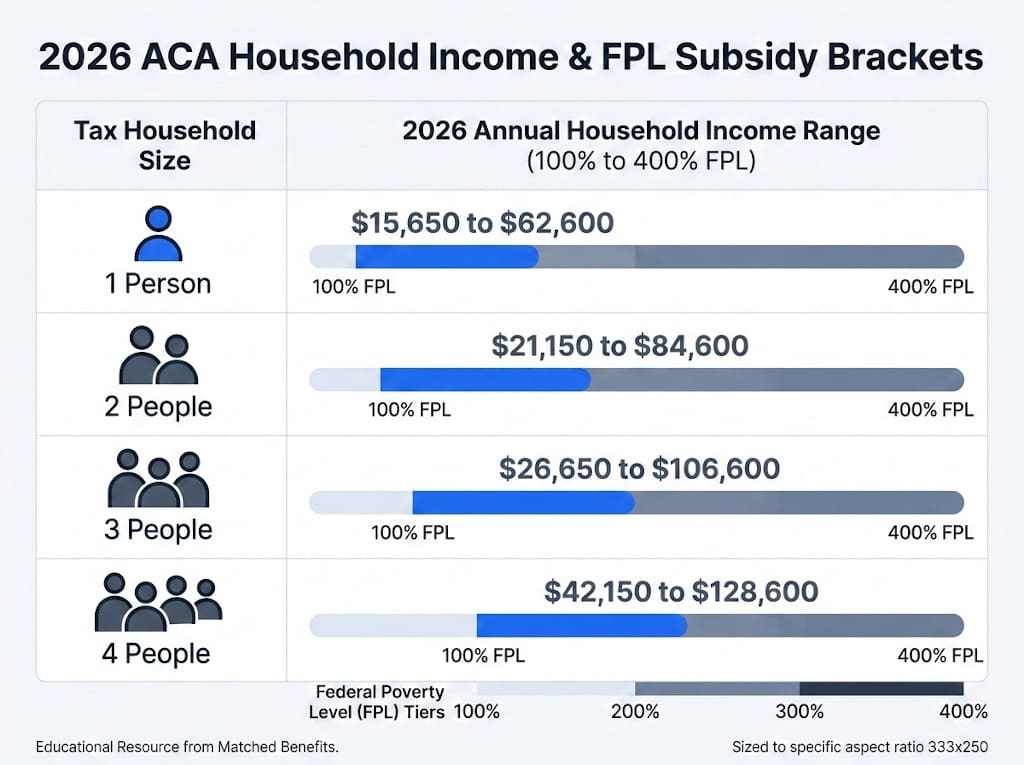
The chart below shows the estimated income brackets (100% to 400% FPL) used to determine subsidy assistance for 2026 coverage across the 48 contiguous U.S. states and Washington, D.C.:
| Tax Household Size | Annual Household Income Range (100% to 400% FPL) |
|---|---|
| 1 Person | $15,650 to $62,600 |
| 2 People | $21,150 to $84,600 |
| 3 People | $26,650 to $106,600 |
| 4 People | $42,150 to $128,600 |
Note: Residents of Alaska and Hawaii have higher baseline income limits due to higher living costs.
What Happens Outside These Income Limits?
If your household income drops below 100% of the Federal Poverty Level, you may qualify for Medicaid depending on your state's guidelines. States that expanded Medicaid offer full health coverage to low-income individuals. In states without Medicaid expansion, options vary, but educational tools from Matched Benefits can help clarify local guidelines.
If your income rises above 400% of the Federal Poverty Level, you can still purchase a comprehensive health plan through the ACA Marketplace at full price. Federal rules ensure that plan costs above a certain percentage of your income remain capped, protecting middle-income families from extreme premium spikes.
3. Navigating Employer Coverage and Health Insurance Alternatives
Many working individuals wonder how job-based coverage affects their eligibility for ACA savings. If your employer offers health coverage, you generally cannot receive premium tax credits for a Marketplace plan unless your workplace plan fails two federal tests: the Affordability Test and the Minimum Value Standard.
- The Affordability Test: Employer coverage is considered affordable if the employee's required monthly contribution for self-only coverage does not exceed a set percentage of their household income (around 8.39% for recent plan years).
- The Minimum Value Standard: The employer plan must pay at least 60% of total covered medical costs and include comprehensive coverage for physician services and inpatient hospital care.
Understanding Carlos's Workplace Offer
Let us look at Carlos, who works for a mid-sized retail company. Carlos earns $35,000 per year. His employer offers a health benefit plan, but the monthly paycheck deduction for Carlos's individual plan costs $320 per month.
When Carlos calculates $320 per month, he realizes it equals $3,840 annually, which is about 11% of his gross annual income. Because this amount exceeds the federal affordability threshold, the workplace offer is officially classified as "unaffordable" under ACA rules. As a result, Carlos qualifies to apply for Marketplace subsidies, unlocking significantly lower monthly plan costs.

Government Programs and Duplicate Subsidies
Federal laws prohibit individuals from receiving duplicate subsidies. If you are enrolled in Medicare, or if you hold affordable employer coverage, you cannot receive advance premium tax credits on the ACA Marketplace.
Children in lower-income families may qualify for the Children’s Health Insurance Program (CHIP), which provides comprehensive low-cost medical coverage. Educational hubs like Matched Benefits help you review these overlapping guidelines so you do not accidentally lose out on appropriate savings.
4. Location, Residency, and Basic Eligibility Rules
To sign up for coverage through the ACA Marketplace, you must meet three standard residency and legal requirements:
- U.S. Residency: You must live within one of the 50 U.S. states or Washington, D.C.
- Citizenship or Legal Status: You must be a U.S. citizen, U.S. national, or lawfully present non-citizen (such as a permanent resident or valid visa holder).
- Incarceration Status: You cannot currently be incarcerated.
Why Your ZIP Code Matters
Your local ZIP code plays a major role in your plan options. Insurance carriers choose which counties and regions they serve. Your ZIP code determines:
- Available Insurance Companies: Different carriers offer plans in different counties.
- Provider Networks: Networks define which hospitals, clinics, and primary care doctors accept your insurance. Common networks include Health Maintenance Organizations (HMOs), Preferred Provider Organizations (PPOs), and Exclusive Provider Organizations (EPOs).
- Plan Pricing: Monthly rates vary based on local healthcare market costs.
If you move to a new ZIP code or cross state lines, your plan availability changes. Moving triggers a special sign-up window, allowing you to select a brand-new plan tailored to your new neighborhood.
5. Timing Your Enrollment: Open Enrollment vs. Special Enrollment Periods
Timing is everything when it comes to enrolling in an ACA plan. You generally buy health coverage during two primary windows: the annual Open Enrollment Period or a Special Enrollment Period (SEP).
The annual Open Enrollment Period takes place every autumn. During this window, anyone who meets basic residency and legal requirements can enroll in or switch health plans for the upcoming year.
Outside Open Enrollment, you can only sign up if you experience a Qualifying Life Event that triggers a Special Enrollment Period.
The 60-Day Rule
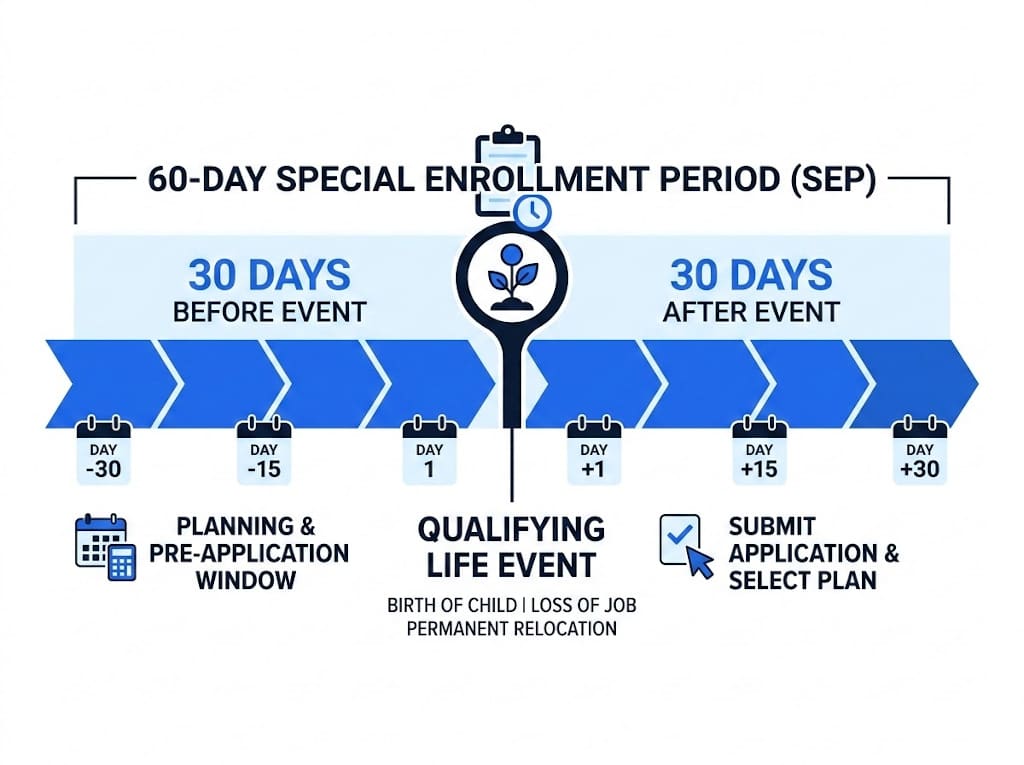
Under federal rules, a Qualifying Life Event grants you a limited 60-day window to secure new coverage. In most cases, you have 60 days before or 60 days after the qualifying event to submit your application.
Understanding Maya and David's Family Expansion
Consider Maya and David, who recently welcomed a baby daughter and moved across the state to a larger home. Both the birth of their child and their relocation to a new ZIP code qualify as major life events.
Maya and David have 60 days from the date of their daughter's birth to update their Marketplace account. By adding their newborn daughter to their tax household, they adjust their overall household size to three people. This update increases their financial assistance eligibility and allows them to pick a comprehensive family health plan within their 60-day window.
Common Qualifying Life Events
Here is a quick list of events that unlock a Special Enrollment Period:
- Loss of Existing Coverage: Losing job-based coverage, turning age 26 and aging off a parent's plan, or losing Medicaid/CHIP eligibility.
- Changes in Household Size: Getting married, getting divorced, having a baby, or adopting a child.
- Permanent Relocation: Moving to a new ZIP code or state that offers different health plan choices.
- Changes in Legal Status: Gaining U.S. citizenship or lawful immigration status.
6. Taxes, Filing Status, and Keeping Your Financial Credits Accurate
Receiving advance Premium Tax Credits creates a direct connection between your health insurance and your annual federal tax return. To remain eligible for these financial credits, you must file a federal income tax return every year.
If you are married, the IRS requires you to file a joint tax return with your spouse to receive Marketplace subsidies. Rare safety exceptions exist for domestic abuse or spousal abandonment, but joint filing remains the general rule for married applicants.
Understanding IRS Form 8962 and Annual Reconciliation
When you receive advance tax credits, the government pays those funds directly to your chosen insurance company each month to reduce your premium bill. At the end of the year, the Marketplace sends you Form 1095-A, which details the exact subsidy amounts paid on your behalf.
When you complete your taxes, you use IRS Form 8962 to reconcile the tax credits you received in advance with the actual income reported on your tax return:
- If your final income matches your estimate: Your tax credit calculation remains perfectly balanced.
- If you earned less than estimated: You may receive an additional tax refund credit.
- If you earned more than estimated: You might have to repay a portion of the tax credit when filing your tax return.
To prevent unexpected tax bills, report income changes, job transitions, or household shifts to the Marketplace right away. Keeping your account details current ensures your financial credits stay fully accurate all year long.

Conclusion: Essential Checklist Before Getting Started
Exploring your health coverage options becomes straightforward when you gather your information ahead of time. Use this simple checklist to prepare your details before reviewing plans:
- Estimated 2026 Household Income: Calculate your projected MAGI, including gross earnings for yourself, your spouse, and any tax dependents.
- Tax Household Details: List everyone who appears on your federal tax return, along with their dates of birth and Social Security numbers.
- Workplace Insurance Details: Gather information about any employer plan options available to your household, including monthly single-coverage costs.
- Residency and Address Information: Have your current street address and ZIP code ready.
- Qualifying Event Dates: Document the exact dates of any recent or upcoming life changes, such as job transitions, moves, marriages, or births.
Understanding your options brings real peace of mind. As an educational resource guide and information hub, Matched Benefits simplifies complex healthcare rules so you can find reliable, low-cost coverage that keeps your family healthy and financially secure.